News & Blog Posts

Witnessing and Unwitnessing Ontario’s Treaties

This post was originally published on ActiveHistory.ca

Last week was the second annual Treaty Recognition Week in Ontario. Organized by the provincial government, this is a time for Ontarians to acknowledge and learn about the treaties upon which the province was developed. This year, Ontario’s Ministry of Education announced that Indigenous history and culture would become part of the K-12 curriculum by fall 2018.

A Wampum Belt Marking the 1764 Treaty of Niagara

In southern Ontario, treaty recognition is sorely needed. Here, the late-eighteenth and early-nineteenth-century treaties that enabled settlement on Indigenous lands remain poorly understood. Though individual First Nations, the Union of Ontario Indians, and the provincial and federal government all provide basic information about these treaties on their websites, most of these initiatives are relatively recent. From a comparative perspective, there are no parallel in-depth studies to the relatively vast literature on treaties elsewhere in Canada.[1] The most comprehensive resource that I have found remains Robert Surtees’s 1984 Land Surrenders in Ontario in addition to a handful of academic journal articles, doctoral dissertations and more local studies.[2]

Continue reading “Witnessing and Unwitnessing Ontario’s Treaties”

What Does Canadian History Look Like? The Story of Us

This post was originally published on ActiveHistory.ca

It is that time of the year again when historians from across the country are preparing to gather together at the Canadian Historical Association’s annual meeting to talk about our work. The theme of meetings, being held in two weeks time, is “From Far and Wide: The Next 150.” As Canada enters the sesquicentennial’s summer season, hallway conversations will no doubt address subjects related to Confederation and its commemoration (or lack thereof, if the first half of the year is any indicator). Perhaps at top of mind will be CBC’s The Story of Us, a ten-part dramatization of the moments some of Canada’s best-known entertainers, politicians, business people and even a few historians wanted to celebrate with high production-value television. The series, as the tone of the previous sentence sought to instil, was widely critiqued by historians (see here, here, herehere, and here).

Looking at this year’s program, however, suggests we may want to be careful in just how loudly we critique the television series. Some of the problems outlined about The Story of Us seem to apply equally to the CHA’s annual meeting. There are two widespread critiques of the television program that might also be applied to the content of this year’s annual meeting. First, The Story of Us was critiqued because it was a unilingual production with little attention to francophone perspectives, their history and culture. Second, the series takes a narrow view on the country’s early history, completely ignoring Indigenous histories before 1600, the importance of the sixteenth and seventeenth century fisheries, and the role of Mi’kmaq, Wabanaki, Innu and Acadian peoples in cultivating early (and foundational) relationships.

Continue reading “What Does Canadian History Look Like? The Story of Us”

Does the Crowd Matter? The Moral Economy in the Twenty-First Century

This post originally appeared on ActiveHistory.ca in February 2017.

Women’s Marches Then and Now

Over the past couple of weeks people around the world have taken to the streets in order to call politicians, business leaders, and civil servants to account. Though similar, no one event was the same. The Women’s March was carefully planned over two months between the US election and Inauguration Day; its purpose was to give voice to the open misogyny expressed by Republicans during the campaign. A week later tens of thousands flooded US airports to support travelers detained due to the idiosyncratic and illegal presidential travel ban targeting Muslims.[1] Two days after that, here in Canada, we mourned the killing of Azzedine Soufiane, Mamaou Tanou Barry, Khaled Belkacemi, Aboubaker Thabti, Ibrahima Barry and Abdelkrim Hassane as they left a Quebec City mosque following prayers. Again, thousands took to the streets across the country voicing concerns over the rise of hate speech and its enablers.

As I participated in, and continue to think about the meaning of, these movements, my attention often turns to the historiography of the crowd. Continue reading “Does the Crowd Matter? The Moral Economy in the Twenty-First Century”

Fake News, Global History Wars, and the Importance of Historical Thinking

This post originally appeared on ActiveHistory.ca in November 2016.

In the last week we’ve seen a strong desire to put an end to “Fake News”. With the rise of social media and increasingly savvy revenue generating fake news sites, this is an important intervention (the dangers of which Alan MacEachern addressed here last week). It is, however, misleading to assign blame for Donald Trump’s rise to the U.S. presidency solely on this blatant deception. Focus on the “fake news” distracts us from the very real way that some producers of the “real news” (editors, producers and pundits) and legitimately elected politicians (and especially governments) use the media to distort and distract in an effort to cultivate public opinion.

Nowhere can this be seen more clearly than in the deliberate (mis)use of history to construct a specific polarized vision of the nation. Globally, politicians and opinion makers (some of whom are admittedly professional historians) have recently turned to un-contextualized facts about their nation’s past for their own political ends, often directly targeting university-based historians and their increasing emphasis on historical thinking over the reinforcement of a national narrative.  Though I am not in a position to argue cause and effect, in this post I would like to suggest that declining enrollments in history programs and classes are perhaps related to the fact that politicians deploying this tactic have recently found electoral success. “Fake news” may be part of the problem, but the problem’s roots go much deeper and relate more directly to established power structures. Continue reading “Fake News, Global History Wars, and the Importance of Historical Thinking”

Acknowledging the Land and the People: A Practice for all Canadian Historians

This post originally appeared on ActiveHistory.ca in July 2016.

Pour assurer notre existence, il faut nous cramponner à la terre, et léguer à nos enfants la langue de nos ancetres et la propriété du sol [1]

Statue of George-Etienne Cartier in Parc Montmorency (Quebec City)

These words captivated my attention a few months ago as I walked across Parc Montmorency, the site of the old parliament buildings in Quebec City. They are found on the footing of a statue of George-Etienne Cartier, one of the better known politicians involved in crafting the British North America Act. What a succinct summary of Confederation, I thought: “In order to assure our existence, we must grasp onto the Land and leave for our children the language of our ancestors and ownership of the soil.”

The words struck a chord, I think, because I was in the park to eat my lunch and read a bit of Thomas King’s The Truth about Stories, the book Huron has chosen for this year’s first year common reading program. Repeatedly, in returning to the phrase: “the truth about stories is that that’s all we are,” King challenges his audience to think about how we situate ourselves in the world and the stories we use to construct it. The story invoked by this inscription is one of a national beginning. It can be read in at least two ways that both help us understand our present moment as well as point us towards areas where our practice as historians may need to change. Continue reading “Acknowledging the Land and the People: A Practice for all Canadian Historians”

Shuttering Archives: A UNESCO Recognized Collection to Close its Doors to the Public

This post originally appeared on ActiveHistory.ca in June 2016.

Le Séminaire du Québec

Last month I spent two weeks working in one of my favourite archives: Le Centre de référence de l’Amérique francophone. This archive – run by Quebec’s Museum of Civilization – is one of the oldest in the country, not only holding the records of the Quebec Seminary (which begin in 1623), but also many important documents related to New France and the early relationship between the diverse peoples of northeastern North America, the French Empire and the Catholic church. The archive holds unique Indigenous language documents and is critical for anyone interested in understanding Canada’s early history. With the Centre located in the seminary buildings themselves, the archive remains more or less in situ since the French regime (bearing in mind that the complex has expanded considerably over the intervening centuries). It is these qualities that led to the collection’s 2007 registration in UNESCO’s Memory of the World Program; a recognition closely linked to Quebec City’s own place on UNESCO’s World Heritage list.

Letters patents of the king for the establishment of the Séminaire de Québec, 1663

It came as a shock then that upon my arrival at the Centre in early May I learned from the reference archivist that this might be my final visit to this important archival collection. On 23 June this archive is scheduled to close for an indefinite amount of time as the Museum of Civilization struggles to meet its budgetary needs. Continue reading “Shuttering Archives: A UNESCO Recognized Collection to Close its Doors to the Public”

What does Canadian history look like? Active History at the 2016 CHA

This post was originally written with Daniel Ross and posted on ActiveHistory.ca in May 2016.

Keywords from the 2016 CHA Program

This weekend, historians from across the country will gather in Calgary for the annual meeting of the Canadian Historical Association (CHA). It’s one of the few opportunities for Canadian historians and historians of Canada to connect in person, share their most recent research, and discuss larger issues facing the profession. Many attendees also take advantage of the chance to learn firsthand about the history of an unfamiliar city or region and its communities. 

Since 2013, we’ve been using a couple of metrics – mainly word counts and chronological markers in paper and panel titles – to provide an overview of what attendees are working on and talking about. There’s nothing particularly rigorous about our methods, but previous posts (201320142015) have provided a starting point for discussions about what Canadian history looks like today, and how that profile has changed over time. 

As always, this year’s line-up speaks to the breadth and creativity of historical work being done in Canada.  Continue reading “What does Canadian history look like? Active History at the 2016 CHA”

Dartmouth College and Canada: The Problem of National Historiographies

This post originally appeared on Borealia in March 2016.

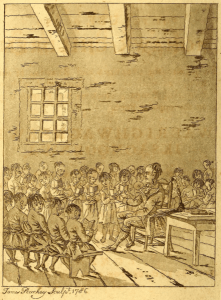
mohawk_school_1786
James Peachey, A Primer for the Use of the Mohawk Children, 1786

When I first learned about Louis Vincent Sawatanen, about a decade ago, I thought that this Wendat man from Lorette was exceptional. Indeed, in many ways he was. Sawatanen was competent, if not fluent, in at least five different languages (Wendat, Mohawk, French, English, and Abenaki). At the end of the eighteenth-century, when the Seven Years’ War, the American Revolution, and the subsequent settler floods that followed these conflicts radically transformed his world, he deftly navigated linguistic and religious chasms, bridging French/English, Patriot/Loyalist, and Protestant/Catholic divides. Indeed, in the midst of turmoil, Sawatanen also attended school, becoming the first Indigenous person from what would become Canada to graduate from a colonial college. He then returned to Lorette in 1791 both to start a school and begin a series of petitions against over a century of settler encroachments.[1]

What I have since learned, however, is that Sawatanen was not alone. Indeed, there are at least a half-dozen similar late-eighteenth-century Indigenous people, whose life stories and interactions with Moor’s Indian Charity School, an institution from which Dartmouth College developed, bear much in common with those of Sawatanen. Continue reading “Dartmouth College and Canada: The Problem of National Historiographies”

Recognizing THEN/HiER

This post originally appeared on ActiveHistory.ca in March 2016.

I first encountered the History Education Network (THEN/HiER) in late 2009, when Jennifer Bonnell, the graduate student coordinator at the time, approached Active History about the potential for coordinating a workshop series in Toronto focused on teaching history. Over the intervening months we worked together towards the first in a series of events that brought together teachers, curators, professors and civil servants known as Approaching the Past. This was the beginning of a six-year partnership between Active History and THEN/HiER. At the end of the month, THEN/HiER’s mandate will draw to a close. I want to use this post to draw attention to our collaboration, some of its key moments, and the influence that Anne Marie Goodfellow, Jennifer Bonnell, Penney Clark and many others have had on ActiveHistory.ca and the Active History project more generally.

Logos Continue reading “Recognizing THEN/HiER”

Indigenous Peoples: A Starting Place for the History of Higher Education in Canada

Is it time to rewrite the history of higher education in Canada? (Middlesex College, UWO, Wikicommons)

This post originally appeared on ActiveHistory.ca in January 2016

“The Bishop of Huron… applied for a grant in aid of the fund being raised by him for the foundation of a university at London, to be called the Western University of London, and intended for the training of both Indian and white students for the ministry of the Church of England in Canada.”

These words about the founding of Western University were printed in an 1879 summary of New England Company activities in Canada and the West Indies (see this document also). They record the Bishop of Huron Isaac Hellmuth’s soliciting funds for a new non-denominational university in southwestern Ontario. The reason they attracted my attention – and should attract yours – was because of the school’s supposed mandate: “the training of both Indian and white students.” This mandate seldom appears in the popular narrative of Western’s founding story, nor those of many other Canadian universities.

In our present-day discussion about First Nations, schooling and education rarely do nineteenth-century mandates like this feature into the conversation. The history of colonial schooling and higher education in Canada hardly addresses Indigenous peoples directly. When the subject arises, Indigenous peoples in schools or colleges are often marginalized and treated as exceptions rather than symbols and signs of historical processes and contexts that can inform our understanding about Canada’s colonial and imperial past (and present). The assumption is that through the assimilationist and segregationist policies of the Canadian state during the mid-to-late nineteenth century, colonists and Indigenous students had fundamentally different and separate experiences. This assumption is certainly and overwhelmingly true and a point that I am not trying to overturn here or in my broader work. Yet this approach obscures as much as it reveals.

When we look at the subject of nineteenth-century higher education with a wider lens we see some important trends that should point us towards a more critical examination of this subject. Indigenous peoples are figuratively, if not physically, often present at the beginnings of many of Canada’s post-secondary institutions.  Continue reading “Indigenous Peoples: A Starting Place for the History of Higher Education in Canada”

Truth and Reconciliation while teaching Canadian History?

This essay was originally posted in November 2015 on ActiveHistory.ca.

TRC coverFollowing the release of the Truth and Reconciliation Commission’s final report six months ago, universities across the country are re-evaluating our practices. Both individually (as recently seen at the University of Winnipeg and Lakehead University) and collectively through Universities Canada’s broad response to the commission’s final report, campuses across the country seem to be making a more concerted effort to respond to this call for change. Perhaps most directly for readers of ActiveHistory.ca, it is the 62nd and 65th calls to action that most directly affect our work as historians and history teachers. Call to action 62 focuses on the importance of collaboration between survivors, Indigenous peoples, educators and governments to provide resources, research and funding to equip teachers with the knowledge and skills necessary to redevelop curriculum and integrate Indigenous knowledge and pedagogies into the classroom; while 65 calls on the Social Sciences and Humanities Research Council, in a similarly collaborative approach, to establish a national research program focused on reconciliation.

Alongside survivor and Elder testimony, history and its practice are central to this report. In a recent talk here at Western, J.R. Miller noted that both in the TRC’s final report and the Royal Commission Report on Aboriginal Peoples, the revisionist work of academic historians feature prominently. He’s right. In addition to Miller himself, scholars like James Axtell, John Borrows, Sarah Carter, Denys Delâge, Robin Fisher, Cornelius Jaenen, Mary-Ellen Kelm, Maureen Lux, John Milloy, Toby Morantz, Daniel Paul, John Reid, Georges Sioui and Bruce Trigger among others reshaped Canadian historiography over the 1970s, 1980s and 1990s. Their work laid the groundwork that – in part – has caused us to rethink and revise how Canada’s history is understood.

And yet, despite this historiographical shift, its influence on the broader structure of Canadian history seems minimal. The place of Indigenous peoples and perspectives flushed out in greater detail, perhaps, but still relegated to a few key moments and periods in Canada’s past. A cursory look at a handful of textbooks in the field, for example, makes the point most clearly.[1] Though textbooks have certainly improved their overall coverage of Indigenous peoples, few have made a substantial revision to their overall structure, only featuring Indigenous peoples as a prominent part of the discussion in a handful of places: European discovery, missionaries and the fur trade, and then interspersed throughout the pre-Confederation period; discussion peters out for the most part in the post-Confederation textbooks until the 1960s/70s (some as late as the 1990s), when Indigenous resistance and political action re-emerged. In today’s post I would like to build on these observations, which are also made in the TRC’s report (pages 234-239 and 246-258), by posing a simple question: How do the TRC’s findings and calls to action shape our teaching of the Canadian history survey course?

Continue reading “Truth and Reconciliation while teaching Canadian History?”

Evaluating our Assumptions: Rethinking Literacies in Canadian History

This essay was originally posted on Borealia: A Group Blog on Early Canadian History in Sept 2015.

Sarah Ainse (Oneida), Kahgegagahbowh (Mississauga), Pahtahsega (Mississauga), Shahwahnegezhik (Ojibwe), Kezhegowinninne (Ojibwe), Kahkewaquonaby (Mississauga), Sawatanen (Wendat), Ferrier Vincent (Wendat), Francois Annance (Abenaki), Pierre Paul Ozhunkarine (Abenaki), Nicolas Vincent (Wendat), Thayendanega (Mohawk), Kanonraron (Mohawk), Sahonwagy (Mohawk), Shawundais (Mississauga), Eleazar Williams (Mohawk), Henry Pahtahquahong Chase (Mississauga), and William Apess (Pequot). These are just a handful of northeastern Indigenous peoples from the late-eighteenth and early-nineteenth centuries who engaged in, and sometimes embraced, a culture of alphabetic literacy.

None of these names will surprise folks familiar with this time and place. Recently a number of important works have illuminated their lives (Kahkewaquonaby, Pahtahsega, Shahwahnegezhik, Kahgegagahbowh, Maungwudaus, Nahnebahwequay, and Shawundais were profiled in Donald Smith’s book Mississauga Portraits, and Michael Oberg, Rick Monture, and Philip Gura have recently published books that touch on Williams, Thayendanega, and Apess, respectively).[1] Despite their well-known biographies and the length of this list, as my work in this area develops I am struck by the fact that many historians continue to treat them as exceptional individuals.

Now don’t mistake this post for an argument that alphabetic literacy was the norm in the late-eighteenth and early-nineteenth century northeast. That’s not the (or even a) point. It’s clear that most of the population (both Settler and Indigenous) lived in a primarily oral culture and that Indigenous literacies and oral practices continued to define both local and regional relationships throughout the period. Nonetheless, the abundance of Indigenous peoples writing letters, petitions, and accounts of their peoples during this period should raise important questions about the place of alphabetic literacy in Northeastern Indigenous communities. How and why did cultures of reading and writing emerge, and why do they become more prominent in the region at the dawn of the nineteenth century? Continue reading “Evaluating our Assumptions: Rethinking Literacies in Canadian History”

Let’s Stand Up and Be Counted: Gender and the Need for a Better Understanding of the Profession

This essay was originally posted on ActiveHistory.ca in July 2015.

Since January I’ve developed a bad habit of becoming completely enveloped by the live concerts on the Apple TV Station Qello. I just can’t stop watching them. A couple of months ago my partner (who wisely goes to bed rather than getting sucked into hours of concert watching) decided to join me. After a few tunes she turned to me and asked if the channel ever played any women artists (they do, periodically). Then she said: “Come to think of it, the music industry is dominated by male artists. Can you think of a musical group where there is a gender balance?” I couldn’t and I still can’t.

Not long after that conversation, I found myself at this year’s annual meeting of the Canadian Historical Association where Lori ChambersElise Chenier and Anne Toews released some of the preliminary results from their analysis of the sex distribution in publications and prizes. The details of that study are really for them to share (though Active History would be happy to serve as a forum for this discussion). Suffice it to say, that their study demonstrates that publishing history in Canada continues to be a highly gendered practice. Since then I’ve been part of a number of conversations (with significantly different groups of people and without me directing the topic of discussion) where similar trends have been suggested in recent hires into tenure track jobs. The argument being that currently men are more likely to get hired than women.

Those of you who read Active History regularly will know that I like to reflect on the nature of the profession. So all of this talk about the gendered nature of the historical discipline got me counting. Over the last few nights I’ve gone through 47 departmental websites counting male and female faculty members in order to get a better understanding of the gendered dynamics of the profession. Like most of my posts written in this vein, this one is not so much a rigorous study as it is an initial impression. I offer it more to spark discussion and further study than as conclusive evidence about our professional culture. Continue reading “Let’s Stand Up and Be Counted: Gender and the Need for a Better Understanding of the Profession”

What does Canadian History Look Like? The CHA in 2015

This essay originally appeared on ActiveHistory.ca in June 2015

For the past two years I’ve written blog posts for the opening day of the Canadian Historical Association’s annual meeting (click here for 2013 and here for 2014). In those posts I created word clouds from the relevant paper and session titles in order to get a sense of what the field of Canadian history actually looks like. As historians gather today in Ottawa for three days of meetings (join us today at 5 pm for the Active History CHA group’s annual meeting), we have an ideal opportunity to take the pulse of Canadian history in order to get a broad sense of where the field is headed.

Today’s post is similar to those in the past. It is an overview (rather than a rigorous study) of the conference program (available here). Importantly, though, today’s post draws some slightly different conclusions than my earlier posts that are perhaps indicative of broader transitions in the field. This year’s program has some interesting things to say, I think, in terms of the place of Indigenous people, situating Canada in a global context, and the place of women in the past.[1] Continue reading “What does Canadian History Look Like? The CHA in 2015”

Lazy Historians, Disengaged Academics, and Over Paid Professors?

This essay was originally posted on ActiveHistory.ca in March 2015.

With thousands of Toronto-area teaching and research assistants out on strike as well as a very recent faculty strike at the University of Northern British Columbia, opinion-makers have begun to draw up proposed solutions for the ailments of higher education. Not surprisingly, given the frequent attention it draws, most have targeted tenured and tenure stream faculty members as the blight on the system that is making higher education unaffordable. Over the past few weeks all three of Canada’s major daily newspapers (click here for the Globehere for the Star, and here for the National Post) explained to their readers through ‘news’ reports or op-ed pieces that the underlying causes of the dramatic rise in itinerant labour is a result of the declining number of full-time over-paid tenured and tenure-track faculty willing to teach.

This type of editorializing – either through the guise of news or through the op-ed pages – is misguided and sets us back from actually achieving workable solutions and robust learning environments in our universities and colleges. Not only does the approach ignore research like CAUT’s, whose annual almanac this year suggests that in six of Canada’s ten provinces, universities spend more money on non-academic staff than academic teaching staff (suggesting that any discussion of costs needs to include the expenses associated with administration, student experience and student life in addition to classroom practices), but more importantly, for the purposes of this post, these attacks on tenured and tenure-track faculty mischaracterize the good work academics (and the students in our classes) are actually up to.[1] Continue reading “Lazy Historians, Disengaged Academics, and Over Paid Professors?”

What’s in a Place Name: Adelaide Hoodless and Mona Parsons

This essay was originally posted on ActiveHistory.ca in February 2015

Adelaide Hoodless with three of her children, circa 1887

Over the past week, ActiveHistory.ca has run a couple of posts about the politics of naming and local commemoration. These essays reminded me of a debate that Paul Bennett and I had a couple of years ago over the merits of renaming schools as the Halifax school board decided that the name Cornwallis was no longer an appropriate moniker for an educational institute (it isn’t BTW). These posts also coincided with a lecture I give every year in the Canadian history survey course on the social gospel, moral reform and suffrage. In this lecture, I spend a few minutes discussing the life and impact of Adelaide Hunter Hoodless, a conservative maternal feminist who played an important role in organizing a number of prominent women’s organizations and more generally in Canadian education at the end of the nineteenth century.

For me, lecturing on Adelaide Hoodless is deeply meaningful. Not only because Hoodless is a fascinating woman but – to be frank – mostly because this is the name of the elementary school I attended in Hamilton, Ontario. So when Kaleigh Bradley posted last Monday about the power of naming and renaming (and the importance of identifying, acknowledging and returning to Indigenous place names), I was reminded of my debate with Paul, where I made a similar argument: names can and should change, and that’s a good thing. In this context, though, and thinking about Adelaide Hoodless, it struck me just how important some settler place names are in determining how we situate ourselves in the world. And sometimes, as I hope to demonstrate at the end of this post, debates over renaming can lead to misguided government policies where naming practices are watered down for fear of controversy.

The impact of the public school’s name on my thinking was a long time coming. Although I spent eight years at Adelaide Hoodless Public School – even visiting her birthplace on a sick day with my Dad – it was not until I started teaching the Canadian history survey course that I came to learn about who Hoodless was and the important ways that she both shaped, and was shaped by, Canadian society. It is quite likely that I would have skipped over her biography in my teaching if it weren’t for the fact that I attended a school named in her honour. But – after digging a little deeper – I’ve increasingly come to believe that Hoodless’s life is worth remembering and teaching. Continue reading “What’s in a Place Name: Adelaide Hoodless and Mona Parsons”

Old Chieftain or Old Charlatan? Assessing Sir John’s Complex Legacy through Political Cartoons

This essay originally appeared on ActiveHistory.ca in January 2015 as part of a theme week examining the legacy of Sir John A Macdonald.

This week ActiveHistory.ca has focused our attention to the legacy of Sir John A. Macdonald. In less than a week’s time, Canada will be in the throws of one big Sir John love-in. On 11 January, this country’s first prime minister will be celebrating the 200th year since his birth in Glasgow, Scotland. Over the course of this week, we’ll bring you essays on Sir John’s legacy regarding Indigenous peoples, immigration and the broader politics of his time. In doing so, we aim to present and assess Sir John in all his complexity. Neither then, nor now, has Canada’s first prime minister been universally celebrated and loved.

John_A_Macdonald_Daguerreotype Continue reading “Old Chieftain or Old Charlatan? Assessing Sir John’s Complex Legacy through Political Cartoons”

The Nation-State is not what we think it is: Teaching Canadian History from a non-national perspective

This essay was originally posted to ActiveHistory.ca in December 2014.

At the beginning of November I was asked to join a panel entitled “No One is International” as part of Huron College’s Centre for Global Studies‘s symposium “Critically Engaging: Global Awareness in the Academy.” As I considered the panel’s title, and the broader purpose for the conference (to critically engage with the meaning of “internationalization” for the college), I decided to frame my reflections around a central question related to my work as a historian of Canada: What does it mean to teach Canadian history (that is, the history of the nation-state) from a non-national perspective? Continue reading “The Nation-State is not what we think it is: Teaching Canadian History from a non-national perspective”

Towards an Active History

This essay was originally posted on ActiveHistory.ca in October 2014

Over the past couple of weeks, the Active History editorial collective has begun the initial planning for a stand-alone conference to be held in late 2015 or 2016. Agreed that there was a need for a conference, we set about to determine the conference’s overall purpose and goals. What quickly became apparent was that we had slightly divergent views about the meaning and practice of Active History. As our conversation continued (and moved toward fruitful resolution), it occurred to me that these varied perspectives might be of interest to the broader readership of ActiveHistory.ca and, through the comments section, provide a good opportunity to hear about your thoughts: What is Active History? Continue reading “Towards an Active History”

Where have all the censuses gone? A Problem with Digital Data

This essay was originally posted on ActiveHistory.ca in July 2014

This post is a little late in coming, but hopefully it will be useful for those of us working in pre-twentieth century North American history or with online resources. About a year ago, I discovered that one of the most useful reference resources I use, Statistics Canada’s E-Stat tables of the Censuses of Canada1665-1871 had been removed from their website. Living in a country where the current federal government has a bit of a history mucking around with censuses and data collection (for good examples see herehere and here), the removal of this resource upset me. Why had I not heard about E-Stat’s impending demise? Where could I retrieve the valuable and accessible data formerly available for download through this website? And (of course) what type of subtle political purpose could be behind the removal of data from Canada’s early censuses?

Stats Can - 2014
Continue reading “Where have all the censuses gone? A Problem with Digital Data”

What does Canadian History Look Like? Impressions from the Periodical Room

This essay originally appeared on ActiveHistory.ca in May 2014

This morning, as you read this post, historians from across the country have gathered at Brock University in St. Catherines, Ontario for the Canadian Historical Association’s annual meeting (click here to read the program). The CHA’s annual meeting is one of the most important forums to hear about new and emerging research on Canada’s past or by historians working in Canada on non-Canadian subjects. This year, panels address computer modeling of battles and pandemics (today at 9 a.m.), the 1200th anniversary of Charlemagne’s death (also at 9 a.m.), surveillance in 20th century Canada (tomorrow at 8:30 a.m.) and Canadian historians and the media (a panel we’re sponsoring at noon on Wednesday). There’s always a little bit for everyone and it’s a good place to familiarize yourself with the breadth of historical work being conducted in Canada.

As such, the CHA’s annual meeting provides a convenient opportunity to reflect on the current state of Canadian history. Last year, at the start of the CHA, I wrote a post analyzing paper titles over the past decade, using them as an index to better understand the subjects on which historians are working (click here to read that post). The theory underpinning that exercise was, when taken collectively, paper titles reveal broader patterns about the state of the field. This year, I’ve embarked on a similar task, looking at the Canadian history papers that will be delivered over the next three days and setting them in a broader context. Instead of rehashing last year’s post, though, I’ve decided to take my study a little further. Rather than looking at past CHA programs, this year I decided to take a look at what some of Canada’s premier history journals suggest about the field as a whole. To do so, like last year, I’ve run article titles from the past decade of Acadiensis, B.C. Studies, Revue d’histoire de l’Amérique française and the Canadian Historical Review through wordle.net (for the visualizations) and Voyant Tools (for the word ranking) to get a better sense of the topics in which Canadian historians are interested.[1]

Continue reading “What does Canadian History Look Like? Impressions from the Periodical Room”

Lessons from the Past, Promises for the Future: Reflections on Historical Thinking in Canadian History

This essay originally appeared on ActiveHistory.ca in March 2014

“Our historians have almost wholly ignored the existence of slavery in Canada.”

Two weeks ago these words echoed through Fountain Commons here at Acadia University.  Historians, educators and activists had gathered for Opening the Academy: New Strategies for Exploring and Sharing African Nova Scotian Histories. The message those of us in the audience heard was that African-Canadian history remains a marginal field in Canadian history. The words above – evoked at the conference, but originally delivered by T. Watson Smith in 1898 to the Royal Nova Scotia Historical Society – still hold true today.[1]

It’s not my intention here to delve into the relative merits of this comparison (though a look through Watson Smith’s address makes one wonder just how far historical research has come over the past 115 years). Rather, I want to use Watson Smith’s statement as a way to introduce a more fundamental point about teaching history and communicating information about the past: it isn’t easy and it’s highly political.

This week ActiveHistory.ca has put together a series of blog posts that focus on the Historical Thinking Project. Scheduled to close its doors at the end of the month, the Historical Thinking Project has made a tangible difference in Canada’s historical landscape. Continue reading “Lessons from the Past, Promises for the Future: Reflections on Historical Thinking in Canadian History”

Canadians and their Pasts on the Road to Confederation

This essay originally appeared on ActiveHistory.ca in January 2014

cdns and pasts

2014 has begun and it looks like another banner year for historical commemoration. The government of Canada has been clear: we’re now on the road to commemorating Confederation. But as the new year begins, the metaphorical road we’re headed down better resembles the roads at the time of Confederation than anything we’re familiar with today (Montreal and Saskatoon excluded). There’s a rocky ride ahead! The past and its uses remain contested ground as Canada’s history and heritage landscape continues to undergo significant, and potentially lasting, change. However, rather than more of the same, the publication of the large-scale survey Canadians and Their Pasts and Canadian Heritage’s recently launched ‘Have your Say’ questionnaire promise that in 2014 the debates of the past few years may take on new dynamics. Continue reading “Canadians and their Pasts on the Road to Confederation”

The politics of proclamation, the politics of commemoration

This essay originally appeared on ActiveHistory.ca in September 2013

October 7th 2013 marks the 250th year since King George III issued what is, for Canadians, the Crown’s most famous Royal Proclamation.  Over the seventeenth and eighteenth centuries, the English monarch released over a hundred royal proclamations.  Some of these proclamations declared war (usually against France), others – such as the Royal Proclamation of October 23rd 1759 – mandated public thanksgiving and celebration, while others focused on more local laws (lotteries in Virginia in 1621, prohibiting trade in Hudson’s Bay in 1688, establishing a post office in 1711, and mandating ‘fast days’ in England during the American Revolution). Few of these proclamations, however, carry the historical legacy of the one issued in October 1763. This morning, ActiveHistory.ca and the Robarts Centre for Canadian Studies presents a week-long series of 14 essays situating this Royal Proclamation in its historical context. Continue reading “The politics of proclamation, the politics of commemoration”

Digital History isn’t for everyone

This essay originally appeared on ActiveHistory.ca in July 2013

Most of the work that we do here at ActiveHistory.ca is what I have called elsewhere, passive history. Though there are a number of important exceptions (such as the History Matters lecture seriesApproaching the Past, community and institutional partnerships), we generally take a ‘field of dreams approach’ to our online content.  If we post it, readers will come. This has been a successful strategy. Since our beginning in April 2009, the website’s readership has continued to grow (now averaging about 15,000 unique visitors a month).

Active History as an idea, however, is broader than the online forum we have created. At its core, an Active History approach to studying the past seeks to be socially transformative and publically engaging. To accomplish these goals, it is important for our work to resonate both online and in the material world (meatspace for those of you familiar with cyber-jargon). In order to be successful Active Historians, then, we need to understand how these two worlds are connected and what possibilities and pitfalls exist when we share our work in one or the other space.

Digital History isn’t for everyone. Continue reading “Digital History isn’t for everyone”